
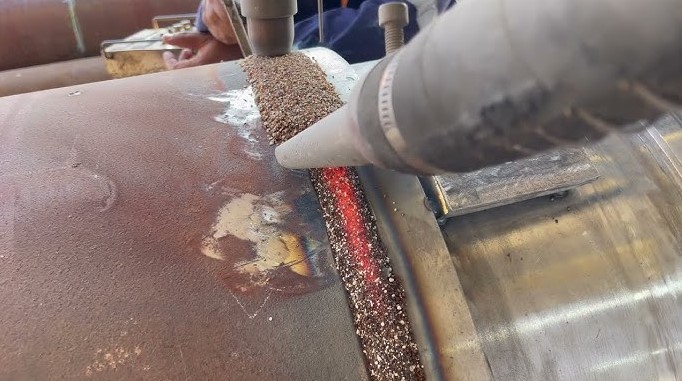
Submerged welding is a highly efficient arc welding process that uses a blanket of granular flux to protect the weld zone from atmospheric contamination. By submerging the arc, this method minimizes spatter, reduces harmful fumes, and allows for deep penetration in thick metal sections.
If you have ever walked through a massive shipyard or looked at the complex infrastructure of a skyscraper, you have likely seen the results of submerged welding in action. In the world of metal fabrication, finding the right tool for the job is everything.
As we move further into 2026, technology in our workshops continues to evolve, yet some core techniques remain the gold standard for heavy-duty work. If you have been asking, “what is submerged welding,” you have come to the right place. It is a process that has stood the test of time by offering a perfect blend of power, speed, and precision.
At its heart, submerged welding is all about control. Imagine trying to solder a delicate circuit board while standing in a windstorm; it would be a nightmare. Welding large steel beams is similar because the air around us contains elements that can ruin a weld.
Submerged welding solves this by burying the entire process under a mountain of specialized material. It is a clean, powerful, and remarkably effective way to join thick metals. Let’s dive into the details and demystify this powerful industrial technique.
Key Takeaways
- Deep Penetration: Submerged welding is ideal for thick plates because it delivers deep, consistent fusion.
- High Efficiency: It is one of the fastest welding methods, making it perfect for heavy manufacturing.
- Superior Quality: The flux blanket provides excellent shielding, resulting in high-quality, clean welds.
- Safety First: Because the arc is hidden, there is almost no visible light or smoke, improving the operator environment.
- Automation Friendly: This process is easily integrated into robotic systems for consistent, repeatable results.
- Specific Applications: It is primarily used for large-scale structural projects, shipbuilding, and pressure vessels.
Understanding the Basics of Submerged Welding
To really grasp what is submerged welding, you have to picture the setup. Unlike standard stick welding where you can see a bright, blinding flash, this method hides everything. You feed a bare metal wire electrode through a welding head. As the wire reaches the metal you want to join, a layer of granular, fusible flux is deposited directly over the joint.
When the machine triggers, the electric arc strikes under that mound of flux. The arc melts the wire, the base metal, and a portion of the flux. As the metal cools, the flux creates a protective slag layer.
This slag keeps the oxygen and nitrogen in the air away from your weld, which helps prevent porosity and brittle joints. Once you are done, you simply brush away the leftover flux, and you are left with a smooth, professional weld.
The Role of Flux in Submerged Welding
The flux is the unsung hero here. It does not just protect the weld; it also helps define the chemistry of the final joint. You can pick different types of flux to match the metal you are working with. Some flux adds alloying elements to the weld pool to make it stronger, while others focus on keeping the weld slag easy to remove. It is like choosing the right spice for a recipe; the flux changes the flavor of the final product.
Equipment Requirements for 2026
In 2026, the equipment for submerged welding has become much smarter. Modern machines are often semi-automatic or fully robotic. You will need a constant voltage power source, a wire feeder, and a flux delivery system. Because the process is so fast, the equipment is designed to handle high current, often exceeding 1000 amps. It is heavy-duty gear built for heavy-duty work.
Why Choose Submerged Welding Over Other Methods?
When you are deciding what is submerged welding and if it fits your shop, think about your volume. This process is not meant for small repairs or thin sheet metal. Instead, it is the king of thick sections. Because it can handle high heat input, you can weld very thick steel plates in just one or two passes. Other methods might require you to make five or six passes to get the same results.
Another major advantage is the lack of visible arc. In traditional arc welding, you need to wear heavy protective gear to block out UV rays. While you still need safety gear in the shop, the “submerged” nature of the process means you aren’t dealing with the same level of blinding light exposure. It makes the work area much more comfortable for the team and reduces the risk of accidental flash burns for others in the vicinity.
Consistency and Automation
Since the process is often automated, you get incredible consistency. Every inch of the weld will look exactly like the inch before it. In industries where structural integrity is a matter of life and death, such as building bridges or pipelines, this reliability is priceless. Humans are great, but machines don’t get tired or shaky after an eight-hour shift.
Environmental and Safety Benefits
We are all more conscious of health these days. Submerged welding produces very little smoke or fumes because the arc is completely buried. This makes it a much cleaner process for your workshop’s air quality. By keeping the welding environment contained, you reduce the need for massive, expensive ventilation systems, provided you manage the dust from the flux correctly.
Applications Across Various Industries
You might wonder where you would actually use this in the real world. Think about massive steel structures. Shipbuilders use submerged welding to join the enormous hull plates of container ships. The deep penetration ensures that the ship can handle the immense pressure of the ocean. It is also common in the construction of storage tanks for oil and gas, where long, straight seams need to be welded with absolute precision.
Manufacturing Pressure Vessels
Pressure vessels are designed to hold hazardous materials at high pressure. Any defect in a weld can lead to a catastrophic failure. Submerged welding provides a uniform, high-quality weld that is far less likely to have internal defects compared to manual welding. It is the go-to method for manufacturing these critical components.
Structural Steel and Infrastructure
When you see large I-beams being fabricated, it is likely that submerged welding is involved. Because the process allows for faster travel speeds, manufacturers can produce these beams much quicker. In the fast-paced world of 2026 construction, time is money, and this welding method keeps projects on schedule.
Practical Tips for Success
If you are new to the process, remember that surface preparation is key. Even though the flux is great at cleaning, it is not a miracle worker. You should always ensure that your metal is free of rust, scale, oil, and moisture. If your joint is damp, it can lead to hydrogen cracking, which is a major headache later on.
Another tip is to pay close attention to your flux handling. Keep your flux dry! If your flux absorbs moisture from the air, it will cause porosity in your welds. Many professional shops use flux ovens to keep their supply warm and dry until the exact moment it is needed on the track. This one simple step can save you hours of grinding and re-welding.
Managing Flux Depth
How much flux should you use? It is a balance. If you don’t use enough, the arc will flicker and you might get weld spatter. If you use too much, it is just wasted material and harder to clean up. Most operators aim for just enough to cover the arc without having a massive pile. Experiment with your machine’s settings to find the sweet spot for your specific joint type.
Common Challenges and How to Solve Them
Even with such a great process, things can go wrong. One of the most common issues is “arc blow,” where the magnetic field pushes the arc away from the joint. This can happen if your grounding is not solid. Always make sure your ground clamps are clean, secure, and placed as close to the weld as possible to keep the current flowing where you want it.
Another challenge is slag removal. Sometimes the slag can stick tight, especially if the heat input is not adjusted correctly for the material thickness. If you find yourself struggling to remove the slag, check your cooling rates. Adjusting your welding speed can often make the slag pop right off, leaving a clean, beautiful bead underneath.
When to Switch Methods
Knowing what is submerged welding also means knowing what it is NOT. Don’t try to use it for overhead or vertical welding. Because you are dealing with a pile of loose, granular flux, the process relies on gravity to keep the material in place. If you try to weld vertically, the flux will just fall off. Keep this process for flat or horizontal fillet welds for the best results.
The Future of Welding Technology
As we look at the landscape of 2026, we see more integration of AI into these welding systems. Sensors can now detect if a weld is starting to deviate and automatically adjust the voltage or travel speed in real-time. This level of precision is incredible. It means that even less experienced operators can achieve high-quality results under the supervision of advanced software.
We are also seeing a shift toward more environmentally friendly fluxes. Companies are developing flux formulas that are easier to recycle, reducing the amount of waste a workshop produces. These innovations are helping to make an already efficient process even more sustainable, ensuring that submerged welding stays relevant for decades to come.
In conclusion, understanding what is submerged welding is about recognizing the value of efficient, heavy-duty fabrication. It is a process that delivers strength, speed, and safety in a way few other methods can match.
By investing in the right equipment, focusing on proper setup, and keeping your materials dry and clean, you can tackle the biggest projects with confidence. Whether you are building the next generation of ships or simply want to improve your production line, this technique offers a solid foundation for your success.
Frequently Asked Questions
Is submerged welding suitable for beginners?
While the process is highly automated and consistent, it is typically used in industrial settings requiring significant technical knowledge. Beginners should start with manual processes like stick or MIG welding to understand the basics of arc physics before moving to industrial submerged systems.
Can submerged welding be used on all metals?
It is primarily designed for carbon and low-alloy steels. While it can be adapted for stainless steel and some nickel alloys, it is not recommended for most non-ferrous metals like aluminum or titanium due to the specific requirements of the flux and the high heat input.
Why do I need to keep my flux dry?
Moisture in the flux introduces hydrogen into the weld pool, which can lead to cracking and porosity. Using a dedicated flux oven to remove all moisture is critical for achieving high-integrity welds in structural applications.
How does the weld quality compare to MIG welding?
Submerged welding generally offers deeper penetration and higher deposition rates than MIG welding, making it superior for thick plates. However, MIG welding is much more versatile for complex joints and thinner materials where mobility is required.
Are there health risks associated with the flux?
Yes, the flux creates dust during handling and operation, which can be irritating to the respiratory system. Proper dust extraction and wearing a respirator are essential safety practices when working in an environment with granulated flux.
What is the maximum thickness I can weld?
The thickness is limited mostly by your equipment’s power output and your ability to control heat input. With multi-pass techniques and high-amperage power sources, submerged welding can easily join plates several inches thick in a single project.