
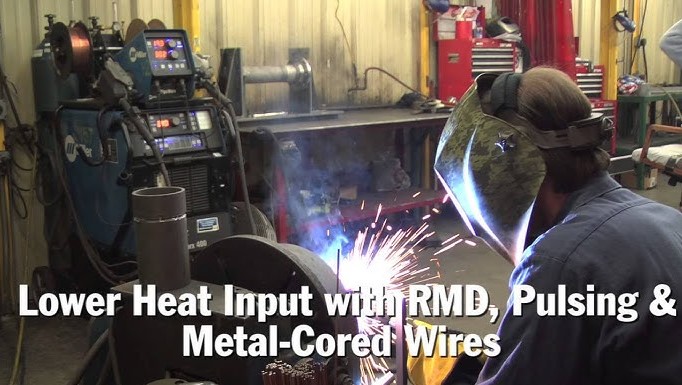
RMD welding, or Regulated Metal Deposition, is an advanced form of GMAW (MIG) welding that precisely controls the current to create a smooth, spatter-free arc. By monitoring the welding cycle in real-time, it stabilizes the root pass on pipes and plates, making it the industry standard for high-quality, efficient welding in 2026.
If you have spent any time around a modern fabrication shop in 2026, you have probably heard the term RMD welding tossed around. It sounds like technical jargon, but it is actually one of the most exciting advancements in metal joining. If you are wondering, what is RMD welding, you are in the right place. At its core, it is a smart way to perform MIG welding that takes the guesswork out of the process.
Traditional welding can be frustrating. You battle burn-through, struggle with spatter, and spend hours grinding down rough root passes. RMD welding, which stands for Regulated Metal Deposition, changes the game by using a computer to “read” the arc thousands of times per second. It is like having an expert welder sitting inside your power source, adjusting the settings for every single droplet of metal.
Key Takeaways
- Precision Control: RMD welding uses high-speed digital processors to manage the droplet transfer, ensuring consistent penetration.
- Superior Root Passes: It is widely considered the best method for open-root pipe welding, replacing traditional TIG in many shops.
- Reduced Spatter: The regulated current eliminates the violent explosions of metal common in standard MIG welding, saving cleanup time.
- Ease of Learning: Because the machine does the heavy lifting, new welders can achieve professional-grade results much faster than with legacy processes.
- Cost Efficiency: By combining speed with quality, RMD welding significantly reduces rework rates and consumable waste.
- Versatile Applications: It is highly effective for both thin materials and challenging open-root gaps in heavy industrial piping.
Understanding the Basics of RMD Welding
To really grasp what is RMD welding, we have to look at how it differs from your standard Short Circuit MIG. In old-school MIG, the wire hits the metal, creates a short, and causes a surge of current that blows the metal off the wire. This is why you get spatter that violent reaction is essentially an explosion. RMD is different because it is “regulated.”
How the Process Works
The RMD process monitors the short circuit. Right before the short occurs, the machine drops the current down. This allows the droplet to transfer smoothly without the explosive force. Because the arc is so stable, you get a clean, consistent weld pool that is much easier to manage. This is especially helpful when you are working on pipe welding where the root pass is critical.
Think of it like driving a car. Older welding machines are like driving a car where the gas pedal only has two positions: floor it or stop. RMD is like having cruise control and an automatic transmission. The machine handles the micro-adjustments so that you can focus on your torch angle and travel speed.
Why it Matters in 2026
In 2026, the industry is focused on speed and quality. Shops cannot afford to have a weld fail an X-ray test. RMD provides that high-quality, high-penetration root pass that used to require a TIG welder. By moving to RMD, shops can produce pipe welds faster while maintaining the same structural integrity. It is not just about convenience; it is about keeping up with modern manufacturing demands.
The Advantages of Switching to RMD
When you ask what is RMD welding, the answer usually revolves around the benefits. If you are a shop owner or a welder looking to up your game, these advantages are hard to ignore. The most obvious benefit is the reduction in rework. When a weld is done right the first time, you save time, money, and materials.
Unmatched Root Pass Quality
One of the biggest headaches in welding is the open-root pass. This is where you join two pieces of pipe with a gap between them. Usually, this requires high skill and a slow hand. With RMD, the machine controls the arc so perfectly that the metal fills the gap smoothly every time. You get better penetration without the risk of blowing a hole through the metal.
Cleanliness and Spatter Control
Nobody likes cleaning up spatter. It takes extra time and makes the shop floor look messy. Because RMD regulates the metal transfer, there is almost zero spatter. This means less grinding, less wire brushing, and a much cleaner final product. You can spend more time welding and less time cleaning.
Is RMD Welding Right for Your Shop?
You might be thinking, this sounds great, but do I really need it? The answer depends on what you are welding. If you are doing light hobby work, maybe not. But if you are doing pipe fabrication, structural steel, or high-pressure vessels, RMD is an absolute must-have in 2026.
Practical Examples of Use
Consider a fabricator working on a stainless steel process piping project. They need a perfect internal root pass to ensure no contaminants get trapped in the line. Traditionally, they would use TIG. However, TIG is slow. By using RMD, they can get the quality of TIG at the speed of MIG. The resulting weld is smooth, passes inspection, and is finished in half the time.
Training and Learning Curve
Another great thing about RMD is that it helps bridge the skill gap. Because the machine handles the arc dynamics, a junior welder can often produce a “certified” quality weld much faster than they would on a standard machine. While it does not replace the need for skill, it gives newer welders a massive head start.
Setting Up Your Equipment
Setting up for RMD is not as complicated as it sounds. Most modern digital welding power sources come with an RMD mode. You just need to select the right wire, shielding gas, and program settings. The software does the heavy lifting for you.
Tips for Success
First, make sure your wire feed speed is set correctly according to the manufacturer’s recommendations. Don’t try to “fight” the machine; the beauty of RMD is that it wants to maintain that stable arc. If you keep your travel speed consistent, the machine will do the rest. Another pro tip is to pay close attention to your contact tip condition. Since RMD is so precise, a worn-out tip can cause instability.
Maintenance and Best Practices
Treat your RMD machine like the computer it is. Keep it clean and dry. Since it relies on digital processors, keep the environment as dust-free as possible. Routine calibration of your machine is also important in 2026 to ensure the pulse settings remain accurate over time.
Comparing RMD to Traditional Methods
Let’s compare RMD to what we used to do. TIG is great for beauty and precision but is undeniably slow. Standard Short Circuit MIG is fast but messy and prone to cold lap. RMD sits right in the “sweet spot.” It offers the precision of TIG with the speed and efficiency of MIG.
The Cost-Benefit Analysis
The upfront cost of an RMD-capable machine is higher than a basic MIG welder. However, when you calculate the cost of labor saved and the reduction in rework, the machine pays for itself very quickly. In the high-stakes world of 2026, efficiency is the only way to stay competitive. Investing in RMD is essentially investing in your shop’s future.
Conclusion
So, what is RMD welding? It is the evolution of the arc. It represents a shift toward smarter, more controlled, and more efficient fabrication. By using digital regulation to manage the welding arc, RMD eliminates the common frustrations of spatter and burn-through, allowing welders to achieve perfect root passes with ease.
Whether you are a seasoned pipe welder or a shop owner looking to increase your output, understanding and implementing RMD technology is a smart move. It simplifies the hard stuff, cleans up the messy stuff, and keeps the quality high.
As we look at the landscape of welding in 2026, it is clear that RMD is not just a trend—it is the new baseline for professional excellence. Start exploring what RMD can do for your projects today, and you will likely never want to go back to standard welding again.
Frequently Asked Questions
Is RMD welding the same as Pulse MIG?
No, they are different processes. RMD is a modified short-circuit process used primarily for root passes, while Pulse MIG is typically used for out-of-position welding and thicker materials.
Does RMD welding require special shielding gas?
Most RMD applications perform best with a specific blend of argon and carbon dioxide, typically 90/10 or 92/8. Always check your machine manual to see the manufacturer’s recommended gas for your specific wire.
Can I use RMD for stainless steel?
Yes, RMD is excellent for stainless steel. It helps maintain the material’s integrity by preventing excessive heat input, which is crucial for corrosion resistance.
Is it harder to learn RMD than TIG?
Generally, RMD has a much shorter learning curve than TIG welding. Because the machine regulates the arc, the welder can focus more on technique rather than constant manual adjustments.
Can any MIG welder do RMD?
Only welders with advanced digital control and specific RMD software can perform this process. It is not a feature found on basic, transformer-based MIG machines.
Why is RMD better for root passes?
RMD prevents the arc from becoming too violent, which allows the weld pool to “wet out” into the root gap without blowing through the metal. This ensures a uniform, high-quality seal on the first pass.