A duty cycle on a welder defines how long your machine can run continuously within a ten-minute window before it needs a cooling break to prevent overheating. Understanding this rating is essential for safety, protecting your gear, and ensuring your welding projects remain efficient without unnecessary downtime.
When you start shopping for a new welding machine in 2026, you will see a lot of technical terms thrown around. One that pops up everywhere is the duty cycle. If you are new to the craft, you might look at a specification sheet and wonder, “What is a duty cycle on a welder?” It sounds like fancy engineering jargon, but it is actually a simple, vital concept that helps you understand how hard your machine can work before it needs a rest.
Think of the duty cycle like a runner sprinting on a track. A sprinter cannot run at top speed for an hour straight without collapsing. They need to sprint, jog, and rest to keep going. A welder is exactly the same. It generates massive amounts of heat to melt metal, and that heat has to go somewhere. If the machine works too hard for too long without a break, the internal parts could melt or fail. Understanding this rating will save you from frustration and costly repairs down the road.
Key Takeaways
- The 10-Minute Rule: Industry standards measure duty cycle based on a 10-minute time frame, making it easy to calculate your machine’s limits.
- Heat Management: A duty cycle on a welder exists primarily to protect internal components from damage caused by extreme operating temperatures.
- Amperage Matters: Your duty cycle changes depending on the power settings; as you turn the amps up, the duty cycle percentage drops.
- Efficiency Boost: Choosing a welder with an appropriate duty cycle for your work prevents constant “cool-down” pauses that kill your workflow.
- Professional vs. DIY: High-end industrial welders offer 60% to 100% duty cycles, while smaller hobbyist models typically range from 20% to 30%.
What Exactly Is a Duty Cycle on a Welder?
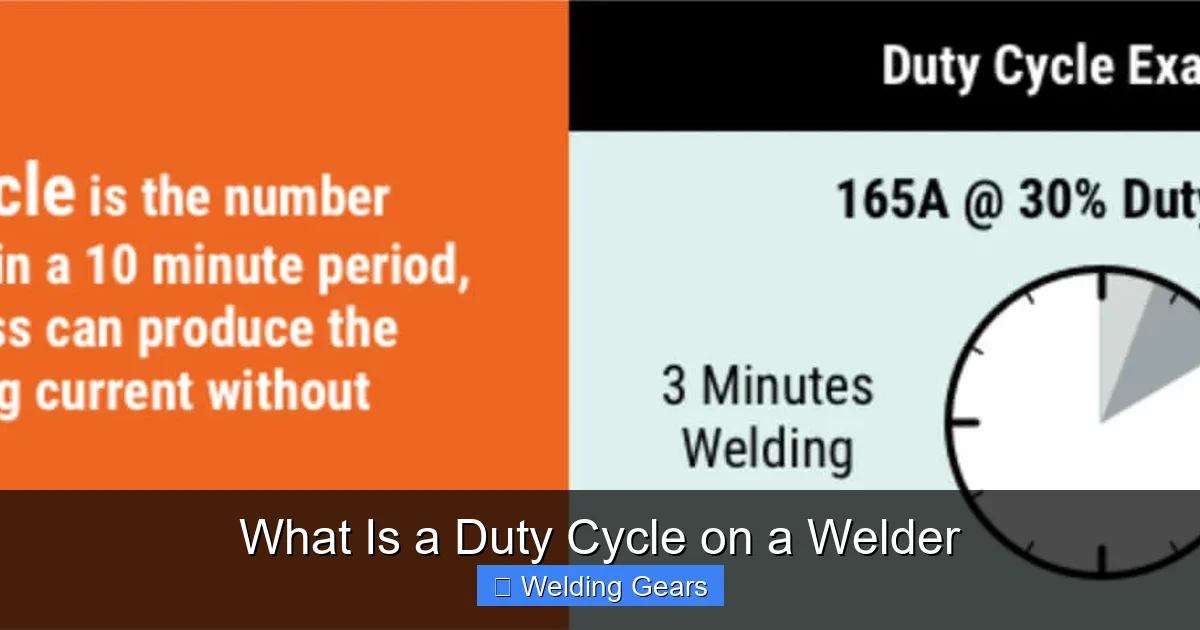
At its core, a duty cycle on a welder is a safety rating. It tells you exactly how many minutes out of a ten-minute period a machine can weld at a specific amperage setting. The industry uses a standard ten-minute window to keep things consistent across all brands and models. This makes it very easy to compare different machines in your shop or hardware store.
Breaking Down the Math
Let us look at a common example to make this concrete. If your welder has a 30% duty cycle at 150 amps, here is what that actually means. During a ten-minute interval, the welder can safely operate for three minutes while you are laying a bead. For the remaining seven minutes, the machine needs to be idle so its internal cooling fans can bring the temperature back down to a safe level.
If you push the machine past that three-minute mark, most modern welders are smart enough to shut themselves off. They have built-in thermal overload protection. While it is annoying when your welder stops mid-weld, this feature is a lifesaver. It keeps you from frying your equipment. When the light goes out or the machine resets, it is your cue that you have hit your limit.
Why the 10-Minute Standard?
You might wonder why we use ten minutes instead of one hour or one day. It is simply a global benchmark. By using a standardized window, manufacturers can clearly explain the performance of their machines. Whether you are buying a machine in 2026 or looking at vintage gear, that ten-minute rule stays the same. It provides a reliable way to compare a small home welder to a massive industrial rig.
How Amperage Affects Your Duty Cycle
This is where things get interesting for the operator. You cannot talk about a duty cycle on a welder without talking about amperage. The relationship is inverse: the more power you pull, the shorter the duty cycle becomes. This happens because higher amperage equals much higher internal heat generation.
High Power vs. Low Power
If you are welding thin sheet metal at a low setting, say 60 amps, your welder might actually run at a 100% duty cycle. This means you could theoretically weld all day without a single break because the machine is not under much stress. However, if you switch to thick steel plates and crank that machine up to its maximum output of 200 amps, the duty cycle might drop to 20%. You will quickly find yourself spending more time waiting for the machine to cool down than actually laying down weld beads.
Matching the Machine to the Task
Before you buy your next piece of gear, think about your projects. If you are mostly doing automotive repairs or light home fabrication, a lower duty cycle is usually fine. You are likely making short, two-inch welds and then stopping to reposition your work. This natural “stop-and-go” pace gives the welder plenty of time to cool down. However, if you are building heavy farm equipment or structural steel, you need a machine that can handle long, continuous beads without tripping the thermal switch.
The Relationship Between Heat and Efficiency
Heat is the enemy of any electrical device, and welders are no exception. Inside your machine, there are transformers, capacitors, and semiconductors. These components are designed to handle high currents, but they have a limit. When a duty cycle on a welder is exceeded, the resistance increases, and heat builds up rapidly. If left unchecked, this heat breaks down the insulation on the wires and eventually causes a short circuit.
The Role of Cooling Systems
In 2026, welding technology has advanced significantly. Manufacturers now use better fans, heat sinks, and thermal conductive materials to keep machines running longer. Some high-end machines feature “fan-on-demand” systems. These fans only kick in when the machine gets warm, which helps keep dust out of the electronics. Other machines run constant air cycles to maximize the duty cycle.
Recognizing Overheat Symptoms
Even with great engineering, you will eventually hit that wall if you push too hard. Watch for a warning light on the front panel of your machine. It is usually a small icon that looks like a thermometer inside a circle. If that light turns on, stop welding immediately. Do not turn the machine off, though! Leave it turned on so the fan can continue to pull air through the unit. Turning it off stops the cooling process and actually makes the wait time longer.
Choosing the Right Welder for Your Needs
When you are shopping, don’t just look at the price tag. Look at the duty cycle. A “cheap” machine might have the amperage you need, but if its duty cycle is extremely low, you will spend your whole day frustrated. Conversely, paying extra for a 60% or 100% duty cycle machine is a waste of money if you are only welding small, intermittent pieces.
Hobbyist vs. Professional Requirements
For most weekend warriors and DIYers, a 20% to 30% duty cycle at full power is plenty. You are likely taking breaks to move clamps, change gloves, or inspect your work. Those natural pauses are part of the cooling cycle. If you are running a professional fabrication shop where time is money, you should look for machines rated at 60% or higher. In a production environment, downtime is expensive, and you need gear that can keep up with a fast-paced work schedule.
Tips for Improving Workflow
If you feel like you are always hitting the duty cycle limit, you might not necessarily need a new welder. Sometimes, a change in technique helps. Try to plan your welds so you are not running one long, continuous bead for five minutes straight. If you can break up your work into smaller sections, you will keep the machine cooler. Also, ensure your workspace is well-ventilated and your welder’s intake vents are clean. A layer of grinding dust over the air intake will drastically reduce your duty cycle by restricting airflow.
Common Myths About Duty Cycles
There are a lot of misconceptions in the welding community. One of the biggest myths is that a higher duty cycle means the welder is “stronger.” This is not true. A machine with a 100% duty cycle at 50 amps is not stronger than a machine with a 20% duty cycle at 200 amps. They are just designed for different types of work. One is for delicate, long-duration tasks, while the other is for heavy, short-burst tasks.
Does Every Machine Have a Duty Cycle?
Yes. Every single electrical welding device, from the smallest portable flux-core unit to the massive submerged arc machines in shipyards, has a duty cycle. It is a physical reality dictated by the laws of thermodynamics. If anyone tells you their machine “never” has a duty cycle limit, they are either mistaken or using a machine that is so overpowered for their task that they haven’t reached the limit yet.
Can You Modify a Welder to Improve It?
You might see advice online about adding extra fans or modifying the internal electronics to improve the duty cycle. Please avoid doing this. Modern welders are precision-tuned systems. Adding external fans rarely helps because the airflow paths are engineered to reach specific hot spots. Messing with the electronics will void your warranty and could create a dangerous fire hazard. It is always safer and cheaper to buy a machine rated for the work you intend to do.
Conclusion: Mastering Your Equipment
Learning what is a duty cycle on a welder is a rite of passage for any welder. It moves you from being a button-pusher to being an operator who truly understands how their tools work.
By keeping an eye on your duty cycle, you protect your investment and ensure that your machine lasts for years to come. In 2026, we have access to some of the most reliable and efficient welding gear in history, and a little knowledge goes a long way in getting the most out of it.
Always remember: the duty cycle is not a limit on your talent, but a guide for your workflow. Work with your machine, respect its limitations, and you will find that you can accomplish almost any project with consistency and professional quality. Happy welding, and stay safe out there!
Frequently Asked Questions
What happens if I ignore the duty cycle?
If you ignore the duty cycle, your welder’s internal thermal protection switch will trip, cutting off the power to stop the machine from overheating. Continued abuse of this limit can melt internal wiring, damage the transformer, and lead to permanent machine failure.
Does a higher duty cycle always mean a better welder?
Not necessarily; a higher duty cycle just means the machine is designed to run for longer periods without a break. It is more important to choose a machine with a duty cycle that matches your specific project needs rather than just picking the highest number.
Can I extend the duty cycle of my welder?
You cannot change the factory-rated duty cycle, but you can improve your real-world performance by keeping your air intake vents clean. Additionally, breaking your work into smaller, intermittent welds rather than long, continuous beads helps the machine stay within its thermal limits.
Does the duty cycle change with different welding processes?
Yes, the duty cycle can vary depending on whether you are using MIG, TIG, or Stick welding, as each process draws power differently. Always check the data plate on the back of your specific machine, as it lists the duty cycle ratings for various modes.
What should I do if my welder overheats?
If the thermal overload light comes on, stop welding immediately but keep the power switch ON. Leaving the machine on allows the internal cooling fan to keep running, which is the fastest way to lower the temperature and get back to work safely.
How do I calculate the duty cycle for a specific project?
You don’t need to calculate it yourself because the machine’s label provides the duty cycle for specific amperage settings. Simply look for the duty cycle percentage at the amperage you plan to run, and remember that for every 10 minutes of operation, that percentage indicates your safe “on” time.