
Arc blow ranks among the most common welding problems that affect weld quality and control. A stable arc helps produce clean, strong welds, while an unstable arc can lead to poor results. Magnetic forces often push the arc away from the intended path, which makes accurate welding more difficult.
This issue appears more often during DC welding and around corners, joints, or heavy steel sections. Welders who understand arc blow can spot the signs early and take the right steps before defects develop. Small changes in technique, grounding, or workpiece position often improve arc stability. Every welding project benefits from better control and consistent performance.
This guide explains what arc blow means, why it happens, and how it affects the welding process. It also covers practical methods that reduce arc movement and help produce cleaner welds with greater confidence across workshop jobs, repair work, and fabrication projects.
Key Takeaways
- Definition: Arc blow in welding is the deviation of the arc caused by magnetic forces acting on the welding current.
- Primary Cause: It is mostly associated with direct current (DC) welding rather than alternating current (AC).
- Magnetic Imbalance: Uneven distribution of magnetic fields around the arc forces it to wander, creating unstable beads.
- Common Fixes: Changing the ground position, using run-off tabs, or switching to AC are effective ways to stop the blow.
- Quality Impact: If left unaddressed, arc blow leads to undercut, excessive spatter, and weak joints that fail inspection.
What Is Arc Blow in Welding?
If you have ever been in the middle of a perfect weld, only to have the arc suddenly jump or wander off course, you have likely encountered the phenomenon known as arc blow. It is one of the most frustrating experiences for a welder. You are cruising along, holding a steady travel speed, and suddenly the arc decides to take a detour.
This usually results in a messy bead, heavy spatter, and a weld that just does not look right. In 2026, even with advanced welding technology, understanding these fundamental physics is still the difference between a pro and an amateur.
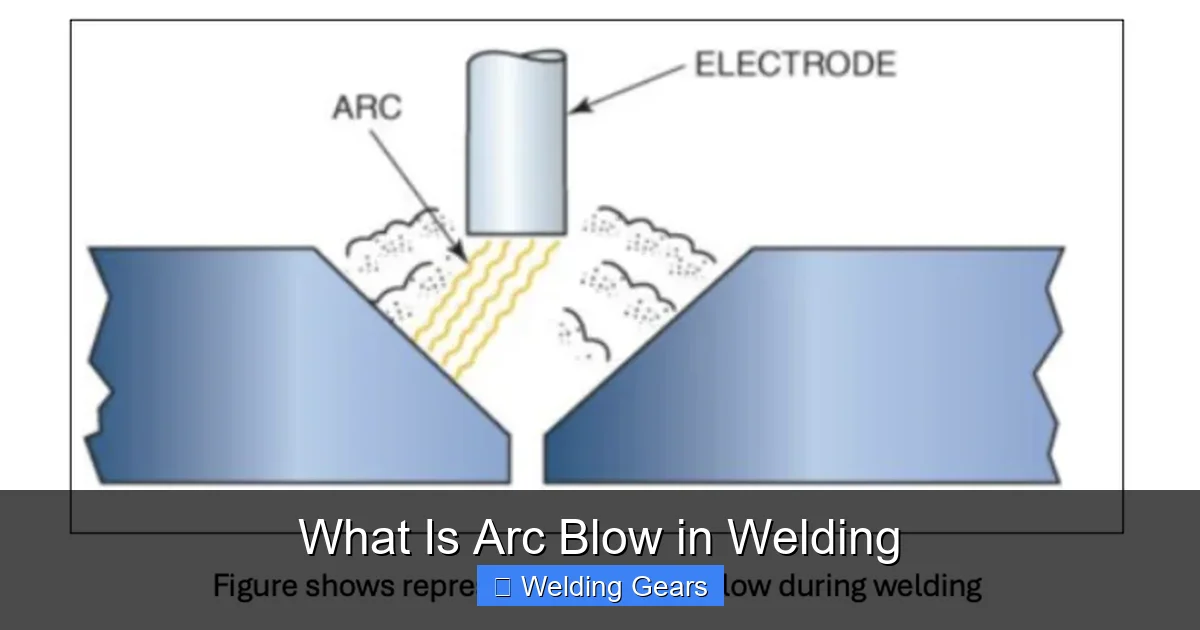
At its core, arc blow in welding is the deflection of the electric arc from its intended path. Instead of going straight down into the joint, the arc gets pushed to one side. This happens because of magnetic fields. When you run a current through your electrode, it creates a magnetic field around that current.
When that field becomes unbalanced, it exerts a force on the arc. Think of it like trying to draw a straight line while someone is gently nudging your hand off to the side. You can fight it, but the line is never going to look as clean as it should.
The Physics Behind Arc Blow
To really master your craft, you need to understand why this happens. Welding is basically a controlled electrical experiment. When you strike an arc, you are creating a path for electrons to flow from your electrode to the base metal. That flow of electrons is an electric current, and every electric current produces a magnetic field. When everything is symmetrical, the magnetic field is balanced, and the arc stays centered.
Magnetic Field Asymmetry
The trouble starts when the magnetic field is not balanced. This is usually caused by the physical shape of the metal you are welding. If you are welding near the end of a long plate, the magnetic field gets compressed on one side. The field lines become denser at the end of the plate, and because the arc wants to follow the path of least resistance, it gets pushed away from that density. This is what we call magnetic arc blow.
The Role of DC Current
Arc blow in welding is almost exclusively a problem with Direct Current (DC). Because DC flows in one direction, the magnetic field remains constant and can accumulate, building up strong magnetic forces. In contrast, Alternating Current (AC) constantly reverses direction 60 times a second.
Because the current keeps switching, the magnetic field never has a chance to build up enough strength to deflect the arc significantly. This is why many welders switch to AC when they are dealing with stubborn arc blow issues.
Types of Arc Blow and How to Spot Them
Not all arc blow is created equal. There are two primary types you will encounter in the shop: Forward blow and Backward blow. Knowing which one you are dealing with is the first step in fixing it.
Forward Arc Blow
Forward arc blow happens at the start of a joint. It occurs because the magnetic field is strongest behind the electrode. As you begin your weld, the arc is pushed forward into the unwelded joint. This often results in a buildup of filler metal at the front, which can lead to excessive penetration or even burn-through if you are not careful.
Backward Arc Blow
This is much more common. As you approach the end of a joint, the magnetic field becomes highly concentrated in the remaining solid metal ahead of the arc. This forces the arc to blow backward toward the weld bead you just laid down. This causes the metal to pile up, creates heavy spatter, and often leads to an undercut at the edges of the weld. It can be incredibly frustrating when you are trying to finish a long seam.
Proven Solutions for Controlling Arc Blow
So, you are in the shop, the arc is wandering, and the weld looks terrible. What do you do? You do not have to just live with it. There are several professional techniques to minimize or eliminate arc blow in welding.
Repositioning the Ground Clamp
The easiest fix is often moving your ground connection. If the arc is blowing backward, try moving your ground clamp to the other end of the work. If it is blowing forward, move the ground clamp closer to the starting point. By changing where the current enters and exits the metal, you can effectively “steer” the magnetic field to balance it out.
Using Run-off Tabs
If you are working on a plate and experiencing blow at the start or end, attach a small piece of scrap metal to the beginning or end of your joint. These are called run-off tabs. They allow the arc to stabilize before it enters the actual joint and prevent the magnetic field from bunching up at the edge of your workpiece. Once the weld is finished, you can simply grind the tabs off.
Switching to AC Welding
If your machine allows it, change your polarity to AC. Because the current reverses direction, the magnetic fields are constantly collapsing and reforming. This prevents the “buildup” of magnetism that causes arc blow. While not every welding process can be done on AC, it is the ultimate “kill switch” for magnetic blow.
Practical Tips for Better Weld Control
Beyond the technical fixes, there are habits you can build that make arc blow less of an issue. Technique is just as important as the physics of the machine.
Adjusting Electrode Angle
If you feel the arc being pushed, try changing your electrode angle. By pointing the electrode slightly against the direction of the blow, you can force the arc to stay in the center of the puddle. It is a bit like compensating for wind when firing a rifle. It takes practice, but it is a vital skill for field welders.
Reducing Current Intensity
Sometimes, we just have too much juice. Using a higher amperage than necessary increases the strength of the magnetic field. Try dropping your amperage slightly and slowing down your travel speed. A smaller, cooler arc is less susceptible to magnetic interference than a high-heat, high-amperage arc.
Shortening the Arc Length
A long arc is a wandering arc. The longer the distance between the electrode and the puddle, the more time and space the magnetic forces have to push your arc off course. Keep your electrode as close to the work as possible. “Tight” welding is not just about penetration; it is about maintaining a stable, focused arc that stays where you put it.
Conclusion
Arc blow in welding is a challenge that every welder will face at some point, but it does not have to ruin your work. By understanding that it is simply a battle against magnetism, you can change the way you approach your setup. Whether it is moving your ground, switching to AC, or just tightening up your arc length, you have the tools to control the arc rather than letting it control you.
As we move through 2026, technology continues to improve, but the basic laws of physics remain the same. Master these fundamentals, and you will find that your welds are cleaner, stronger, and much more consistent. Keep practicing, keep experimenting, and do not let a little magnetic field get in the way of a perfect bead.
Frequently Asked Questions
What is the main cause of arc blow in welding?
The main cause is magnetic field imbalance. When the magnetic field around the arc is unevenly distributed, it forces the arc to deviate from its path.
Does arc blow affect all types of welding?
Arc blow primarily affects DC welding. AC welding is rarely affected because the current direction switches constantly, preventing magnetic buildup.
Can changing the ground clamp location help?
Yes, moving your ground clamp is one of the most effective ways to balance the magnetic field. Try placing it at the opposite end of the joint to see if the arc stabilizes.
Why does the arc blow more at the end of a plate?
The magnetic field becomes highly concentrated at the end of a metal plate because the current path is restricted. This concentration exerts a strong force that pushes the arc backward.
What are run-off tabs?
Run-off tabs are pieces of scrap metal welded to the beginning or end of a joint. They provide a space for the arc to start or finish without being affected by edge-related magnetic interference.
Is arc blow a sign of a bad welding machine?
No, it is usually a result of physics and workpiece geometry. While some high-end machines have features to manage it, arc blow is a standard physical challenge in DC welding that can be managed with proper technique.