Inductance in welding is the electronic control of current rise time, allowing you to fine-tune arc stiffness and puddle fluidity. Mastering this setting helps you reduce spatter, improve penetration, and achieve a smoother bead profile on various metal thicknesses.
If you have ever spent hours grinding down spatter or struggling to keep your arc stable on thin sheet metal, you know that welding is about more than just holding a torch steady. It is about understanding the science behind the current.
One of the most misunderstood settings on modern welding machines is inductance. If you have ever wondered, what is inductance in welding, you are not alone. It is the hidden tool that transforms a frustrating weld into a professional-grade finish.
In the world of 2026 welding technology, our machines are smarter than ever, giving us granular control over how the electricity behaves at the tip of the wire. Inductance essentially acts as a buffer for the electrical current. Think of it like the suspension system in your truck. Just as a suspension absorbs the bumps in the road, inductance absorbs the “bumps” in your welding current. It allows you to customize the arc characteristics to match your specific project needs.
Key Takeaways
- Arc Control: Inductance acts as an electronic damper, slowing down or speeding up the current flow to stabilize the arc.
- Spatter Reduction: Higher inductance settings help reduce spatter by slowing the short-circuit frequency, making the puddle more fluid.
- Penetration Profile: Lower inductance leads to a “crisp” or “digging” arc, while higher inductance creates a “soft” or “buttery” arc.
- Material Compatibility: Thicker steel often benefits from lower inductance for deep penetration, while thin gauge metals prefer higher inductance.
- Efficiency Boost: Using the right settings minimizes post-weld cleanup, saving you time and money on every project.
Understanding the Basics of Inductance
At its core, inductance is the ability of an electrical circuit to store energy in a magnetic field. In a MIG (Gas Metal Arc Welding) setup, the inductor is a coil of wire inside your power source. When you pull the trigger, electricity flows through this coil. The coil resists rapid changes in current, which gives you a level of control over the arc that would be impossible otherwise.
How Inductance Affects Current Flow
When the wire touches the workpiece, a short circuit occurs. Without inductance, the current would surge instantly to a very high level, causing an explosion of molten metal, which we call spatter. The inductor slows that surge down. By managing the rise time of the current, the inductor keeps the arc stable during those micro-short circuits. This is why inductance is often referred to as “arc control” on many machine interfaces today.
The Relationship Between Inductance and Resistance
You can think of inductance as the “softness” of the arc. If you set your inductance to a low level, the current rises very quickly. This creates a crisp, aggressive arc that bites into the metal. It is excellent for overhead welding or when you need deep penetration. If you set it to a high level, the current rises slowly. This creates a soft, fluid arc that is perfect for welding thin materials without burning through.
The Impact of Inductance on Weld Quality
Now that we know what is inductance in welding, let’s talk about the results you see on the workbench. Your settings directly dictate how your bead looks and how much cleanup you have to do afterward. In 2026, efficiency is the name of the game, and dialing in your inductance is a quick win for your bottom line.
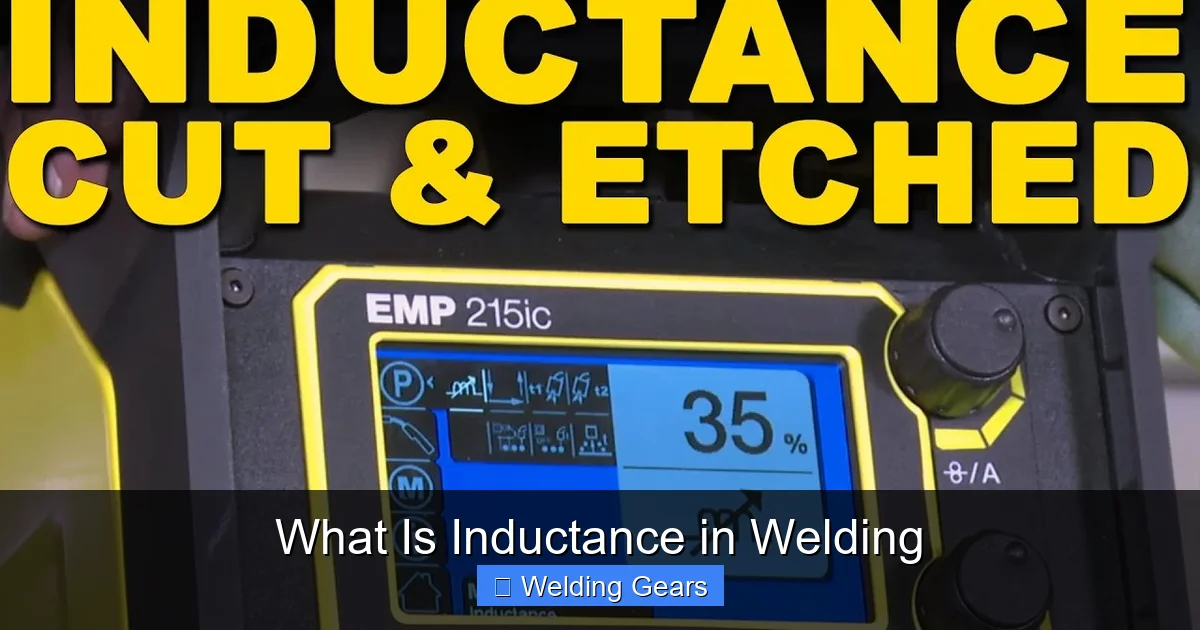
Visual guide about What Is Inductance in Welding
Image source: i.ytimg.com
Managing Spatter Like a Pro
Spatter is the enemy of productivity. High inductance is your secret weapon for spatter control. Because high inductance slows down the current spike during the short-circuit phase, the molten metal transfers more gently across the arc.
This reduces the number of tiny droplets that fly away from the weld zone. If you are doing finish work that needs to be painted or powder-coated, turning up your inductance will save you a massive amount of cleanup time.
Fine-Tuning Puddle Fluidity
The fluidity of the weld puddle determines how easy it is to manage the weld bead. At high inductance settings, the puddle becomes “wetter” and spreads out more easily. This is perfect for cosmetic welds where you want a flat, smooth profile.
Conversely, if you are welding a tight gap or a groove, you might want to lower the inductance. A lower setting makes the puddle stay more focused, giving you better control over the root pass.
Practical Tips for Adjusting Inductance
It is easy to get overwhelmed by all the dials and digital menus on modern welders. Most welders find the “sweet spot” by starting at the mid-point of the machine’s range and adjusting from there. But there are some general rules of thumb that will get you closer to perfect welds faster.
When to Lower Your Inductance
Lower your inductance when you are working on thicker materials that require deep penetration. If you are welding heavy structural steel, you want a snappy, aggressive arc. This “crisp” feeling helps you maintain a tight arc length and keeps the heat focused exactly where the filler metal needs to fuse with the base material. It is also helpful when you are welding out of position, as the shorter, more focused arc is easier to hold in place.
When to Increase Your Inductance
Increase your inductance when you are working with thin gauge sheet metal, such as stainless steel or automotive body panels. High inductance provides a soft, buttery arc that is much less likely to blow holes through the material. It gives you the extra split second you need to manipulate the puddle without losing control. If you feel like your weld is “popping” too much, turning the inductance up is almost always the solution.
Common Misconceptions About Inductance
There are many myths floating around the shop floor. One of the biggest is that inductance changes your voltage or wire speed settings. It is important to remember that inductance is a supplemental setting. It does not replace the need to dial in your primary parameters first.
Inductance vs. Voltage
Voltage controls the heat and the length of the arc. Wire speed controls your amperage or how much filler metal enters the puddle. Inductance, however, controls the timing of the energy delivery. You can have the perfect voltage for the material thickness, but if your inductance is wrong, the arc will feel “wrong.” Always set your voltage and wire speed first, then use inductance to fine-tune the feel and spatter levels.
The “One Size Fits All” Trap
Many beginners try to find one setting that works for everything. In 2026, we have the technology to store presets for a reason. Do not be afraid to save different inductance profiles for different jobs. A setup that creates beautiful stainless steel joints will be completely different from one that lays down strong beads on mild steel angle iron. Treat your inductance settings as a custom recipe for every specific welding job.
Advanced Troubleshooting: Reading Your Arc
Your ears are just as important as your eyes when welding. If you listen closely to the sound of your MIG arc, you can tell exactly what your inductance is doing. A crisp, crackling sound (like bacon frying) usually indicates lower inductance. A smooth, humming, or “frying” sound with very little popping indicates higher inductance.
Troubleshooting Poor Fusion
If you notice cold laps or lack of fusion at the toes of the weld, your inductance might be set too high. Because the arc is so soft, it may not be digging into the sides of the joint effectively. Try lowering your inductance to sharpen the arc and drive more heat into the edges of the base metal.
Dealing with Porosity
While shielding gas is the main culprit for porosity, arc stability plays a role too. If your arc is inconsistent, the gas coverage can be disrupted. By finding the right inductance setting for your wire speed, you create a more stable, predictable arc, which helps ensure that your shielding gas stays exactly where it needs to be to protect the molten puddle.
The Future of Inductance in 2026 and Beyond
As we move through 2026, we are seeing more machines with AI-integrated arc monitoring. These machines can automatically suggest inductance settings based on the metal type and thickness you select on the screen. However, even with all this automation, the human element remains vital.
The Role of Experience
No computer can replace the intuition of a skilled welder. Knowing what is inductance in welding allows you to take control when the automated settings don’t quite feel right for your specific hand speed or travel angle. As you gain experience, you will learn to adjust your inductance on the fly, making tiny tweaks to compensate for gaps in the fit-up or changes in the metal quality.
Final Thoughts on Arc Control
Welding is an art form backed by rigorous physics. By mastering inductance, you are moving past just “sticking metal together” and into the realm of professional fabrication. Whether you are building a custom car frame or working on a home project, the ability to control the stiffness and fluidity of your arc will elevate the quality of your work instantly.
Remember, don’t be afraid to experiment. Take a piece of scrap metal, set your machine to your standard voltage and wire speed, and then run a series of beads while changing the inductance from its minimum to its maximum. You will quickly see and hear the difference. This simple test will teach you more than a thousand pages of technical manuals. Happy welding!
Frequently Asked Questions
Does increasing inductance always reduce spatter?
Generally, yes, because higher inductance slows the current spike during short-circuit transfer, leading to a more controlled metal transfer. However, if the inductance is set too high for the specific wire speed, you may notice an unstable arc or a lack of penetration.
Can I change inductance while I am welding?
Most modern machines allow you to adjust settings via a remote or a foot pedal, but it is best to practice and dial in your settings on a scrap piece before starting the actual weld. Once you are comfortable, you can make micro-adjustments during a long bead if needed.
How does inductance affect heat input?
Inductance affects how the heat is distributed rather than the total amount of heat. Higher inductance creates a wider, softer heat spread, while lower inductance focuses the heat into a tighter, more concentrated point.
Is inductance relevant for TIG welding?
Inductance is specifically a feature of MIG (GMAW) welding power sources. In TIG welding, you control your heat input with a foot pedal, which achieves a similar level of control over the puddle that inductance provides in MIG welding.
Will high inductance make it easier to weld thin metal?
Yes, high inductance is ideal for thin materials because it softens the arc and prevents the “burn-through” common with a more aggressive, lower-inductance setting. It provides a more fluid, forgiving puddle that is easier to manage.
What if my welder does not have an inductance adjustment?
If your machine lacks this feature, it likely has a factory-set, fixed inductance. In these cases, you can influence the arc characteristics slightly by changing your contact tip-to-work distance or adjusting your travel speed.