Welding is the backbone of modern construction and manufacturing, relying on four primary techniques to join metals. Whether you are a hobbyist or a professional, understanding the specific mechanics of MIG, TIG, Stick, and Flux-Cored welding is essential for selecting the right tool for your project.
If you have ever looked at a massive skyscraper, a custom car, or even a simple patio chair, you are looking at the result of welding. As we move through 2026, the technology behind joining metals has never been more accessible. However, the sheer number of methods can feel overwhelming. Many beginners often ask, “What are the 4 main welding processes?” and why do they all exist?
The truth is that no single method is perfect for every job. Each of the four major processes—MIG, TIG, Stick, and Flux-Cored—has its own personality, strengths, and specific use cases. By learning these four, you gain the skills needed to tackle almost any fabrication or repair task you can imagine.
Key Takeaways
- MIG Welding: Known for its ease of use and speed, making it perfect for beginners and automotive repairs.
- TIG Welding: Offers unmatched precision and clean results for thin metals like aluminum and stainless steel.
- Stick Welding: The most portable and versatile process, ideal for outdoor projects and heavy-duty structural repair.
- Flux-Cored Welding: Designed for high-deposition rates in heavy construction where speed and penetration are vital.
- Selection Matters: Choosing the right process depends on material thickness, the environment, and the required finish quality.
- Safety First: Regardless of the method, proper PPE and ventilation remain the top priorities for every welder in 2026.
1. MIG Welding: The Go-To for Speed and Ease
MIG stands for Metal Inert Gas welding, though it is officially known as Gas Metal Arc Welding (GMAW). If you are looking for the easiest way to start your journey as a welder, this is it. Think of it like using a hot glue gun, but for metal.
How MIG Works
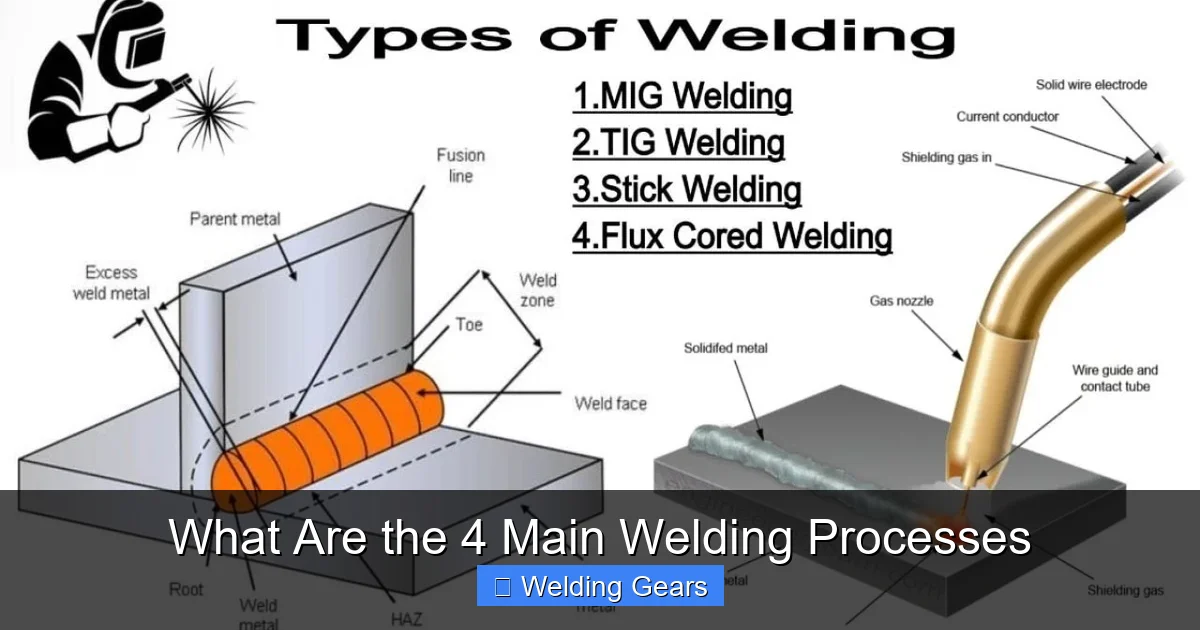
MIG welding uses a spool of wire that feeds through the welding gun at a constant speed. As the wire comes out, an electric arc melts it to create a bead. A shielding gas flows from the nozzle to protect the weld from air contamination. It is fast, efficient, and leaves a very clean finish.
Best Applications for MIG
Because it is so user-friendly, MIG is the king of automotive shops and hobbyist garages. You will find it used for frame repairs, bodywork, and general home projects. If you are fixing a trailer or building a metal workbench, MIG is likely your best friend.
Tips for Success
Always ensure your work surface is clean. Even though MIG is forgiving, rust and paint can ruin the bond. Also, keep an eye on your wire feed speed. If it sounds like sizzling bacon, you are doing it right!
2. TIG Welding: The Gold Standard for Precision
TIG welding, or Gas Tungsten Arc Welding (GTAW), is the artist of the welding world. It is not as fast as the others, but it produces the most beautiful and strong welds. In 2026, as high-end fabrication becomes more popular, TIG has become a must-have skill.
Visual guide about What Are the 4 Main Welding Processes
Image source: i.ytimg.com
The TIG Experience
This process uses a non-consumable tungsten electrode to heat the metal. You hold the torch in one hand and add a filler rod with the other. It requires a lot of coordination, almost like playing a musical instrument. It is slow, but the control you get is incredible.
Why Pros Choose TIG
When you see a custom exhaust pipe or an aerospace component with those perfect “stack of dimes” ripples, that is TIG. It is the best process for thin materials, stainless steel, and aluminum because it allows you to control the heat input precisely without burning through the metal.
Practical Advice
Patience is everything with TIG. Do not rush your bead. Use a foot pedal to control your amperage while you move along the joint. It takes time to learn, but the results are worth the effort.
3. Stick Welding: The Rugged Outdoor Specialist
Stick welding, or Shielded Metal Arc Welding (SMAW), is the “old reliable” of the industry. It has been around for decades and remains the most popular method for heavy-duty field work. It does not require a gas tank, which makes it incredibly portable.
Understanding Stick Welding
The process uses a consumable electrode coated in flux. When the arc hits the metal, the flux melts and creates a gas shield, while also forming a layer of slag over the weld to protect it as it cools. You will need to chip away that slag once you finish your bead.
Where Stick Shines
Stick welding is perfect for outdoor environments where wind would blow away the shielding gas of a MIG or TIG machine. Farmers use it to fix tractors in the field, and construction crews use it for bridges and heavy structural steel. It works even if the metal is a little dirty or rusty.
Tips for Beginners
Stick welding can be messy compared to MIG, so wear your protective gear carefully. You will have to deal with sparks and slag. Focus on maintaining a steady arc length. If the rod sticks to the metal, just give it a quick twist to break it free.
4. Flux-Cored Welding: The Heavy Hitter
Flux-Cored Arc Welding (FCAW) is similar to MIG, but with a twist. Instead of solid wire, it uses a hollow wire filled with flux. It is designed for heavy-duty applications where you need to move fast and get deep penetration.
How FCAW Operates
There are two types of flux-cored welding. Some use an external shielding gas, while others rely entirely on the flux inside the wire. Because the flux is built-in, this process is powerful and can handle thick plates of steel with ease. It is a workhorse in shipbuilding and heavy manufacturing.
FCAW Applications
If you are working on heavy equipment or thick structural components, flux-cored welding is often faster than stick welding. It allows for high production speeds, making it ideal for factories that need to push out large volumes of work every single day.
Getting the Best Results
Because it creates a lot of smoke and spatter, always ensure you have excellent ventilation. You might need to adjust your settings based on the thickness of the metal. Always practice on scrap pieces before you jump into your main project.
Comparing the 4 Main Processes
Now that you know what are the 4 main welding processes, how do you pick? It really comes down to your environment and your material. If you are indoors on a car project, go with MIG. If you are doing delicate artistic work, TIG is the way to go. If you are in a windy field, Stick is your best choice. If you are welding thick steel beams, look at Flux-Cored.
In 2026, technology has made these machines smaller and more efficient than ever. Many modern units even offer “multi-process” capabilities, allowing you to switch between MIG, TIG, and Stick on one single machine. This is a game-changer for home hobbyists who have limited space in their garages.
Conclusion
Learning what are the 4 main welding processes is the first step toward mastering the trade. Each method—MIG, TIG, Stick, and Flux-Cored—offers unique advantages for different situations. By practicing each one, you will build a toolkit of skills that allows you to fix, build, and create almost anything.
Remember that welding is as much about safety as it is about skill. Always wear your helmet, gloves, and protective clothing. Stay patient, keep practicing, and enjoy the satisfaction of melting metal into something useful and strong. The world of welding is wide open to you, so pick up a torch and start building your legacy today!
Frequently Asked Questions
Which welding process is easiest for a beginner to learn?
MIG welding is widely considered the easiest process for beginners. It features a wire feed system that does most of the heavy lifting, allowing you to focus on your hand speed and torch angle.
Do I need shielding gas for all four processes?
No, you do not. Stick welding and self-shielded Flux-Cored welding create their own protection through the burning flux, meaning they do not require external gas tanks.
Can I use the same welding machine for all four processes?
While some modern multi-process welders can handle MIG, TIG, and Stick, Flux-Cored usually requires a specific wire drive setup. Always check your machine’s manual to see what processes it is compatible with.
What is the main difference between MIG and Flux-Cored welding?
The main difference is the wire. MIG uses solid wire and requires external gas, while Flux-Cored uses a hollow wire filled with flux to provide the necessary shielding and metal properties.
Why is TIG welding considered so difficult?
TIG welding requires the welder to use both hands simultaneously—one for the torch and one for the filler rod—while managing a foot pedal for heat control. This coordination takes significant practice to master.
Is Stick welding still relevant in 2026?
Absolutely, Stick welding remains essential because of its portability and reliability. It is still the preferred method for heavy construction, pipeline work, and field repairs where gas cylinders are impractical.